Self-aligning active particles
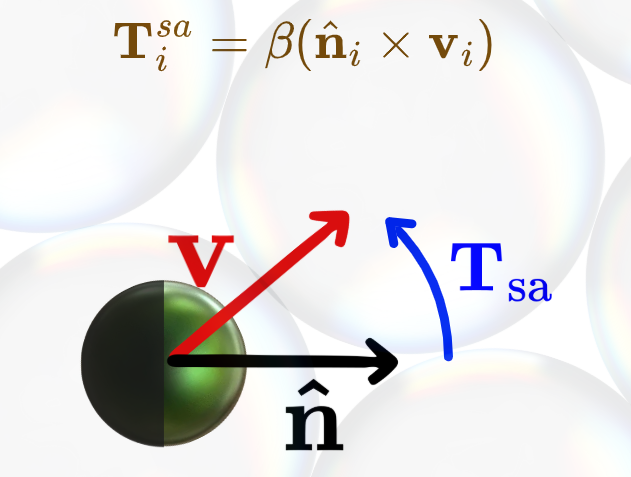
In active matter systems, the self-alignment mechanism, which aligns the particle orientation with its instantaneous velocity, can profoundly affect collective behaviour. At high densities, sufficiently strong self-alignment suppresses MIPS and induces a transition from a disordered state to a homogeneous flocking state, even in crystalline configurations. In the latter case, the transition can be analytically described within a Landau–Ginzburg theory. The introduction of chirality further enriches the phase diagram, favouring the formation of rotating crystals (circling crystals) and, at higher chirality, vortex-like structures.
2024 - oggi